Why This Matters
Every three years, the NFPA updates the National Electrical Code, and every cycle brings changes that directly impact your daily work. Whether your jurisdiction has already adopted the 2023 edition or is still on the 2020 cycle, knowing these changes is essential — for pulling permits, passing inspections, and especially for anyone studying for their journeyman or master exam.
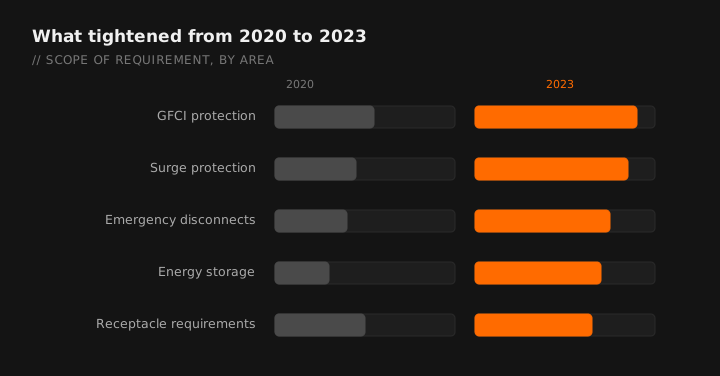
The 2023 NEC (NFPA 70) included over 3,000 public inputs and resulted in hundreds of revisions. We're not going to cover all of them — just the ones most likely to affect the work you do every day.
1. Expanded GFCI Protection Requirements
Article 210.8 — Major Expansion
The 2023 code significantly expanded where GFCI protection is required in dwelling units. The big changes include extending GFCI requirements to cover all 150-volt-to-ground, 50-ampere or less receptacles in dwelling unit kitchens, bathrooms, laundry areas, and outdoors. This means that 240V receptacles in these areas — like a range receptacle in a kitchen — now need GFCI protection in many cases.
Additionally, GFCI protection was extended to indoor damp and wet locations for non-dwelling occupancies, covering more commercial and industrial receptacles than previous editions.
Around 35 states are on the 2023 NEC today. The app's assistant is trained on it.

For electricians in the field, this means more GFCI breakers and devices on your material list. Make sure you're checking whether your jurisdiction has adopted 2023 before quoting jobs — the added GFCI protection affects pricing.
2. Emergency Disconnects for One- and Two-Family Dwellings
Article 230.85 — Now Enforced Widely
This was technically introduced in the 2020 code, but the 2023 edition refined and clarified the requirements. Every one- and two-family dwelling must have an emergency disconnect that is readily accessible and located outdoors. The disconnect must be installed at a readily accessible location outside the building and be marked as an emergency disconnect.
The intent is to give first responders — firefighters specifically — a way to kill power to a structure without entering it. The 2023 code added clarity around:
- Marking requirements (the disconnect must be clearly identified)
- Maximum height and accessibility from grade
- Grouping of disconnects when there are multiple services
If you're doing residential service upgrades or new construction, this is now standard practice in 2023-adopted jurisdictions. Plan for it in your panel layout.
3. Surge Protection for Dwelling Units
Article 230.67 — Surge Protection Required
The 2020 NEC first required surge protective devices (SPDs) for dwelling units, and the 2023 edition maintains and reinforces this requirement. All dwelling unit services must have a Type 1 or Type 2 surge protective device installed.
This is a straightforward add to every residential service call. A Type 2 SPD installed at the panelboard satisfies the requirement. The cost is minimal — typically $50-150 for the device — and it's now part of every residential service upgrade or new installation.
4. Energy Storage Systems (ESS)
Article 706 — Expanded and Reorganized
With the growth of battery backup systems like Tesla Powerwall, Enphase, and others, the 2023 NEC significantly expanded Article 706 covering Energy Storage Systems. Key changes include:
- Clearer disconnecting means requirements for ESS installations
- Updated marking and labeling requirements
- More specific requirements for ESS in one- and two-family dwellings
- Updated requirements for bidirectional power flow
If you're installing battery backup systems — and more homeowners are asking for them every day — you need to be familiar with the updated Article 706.
5. GFCI Protection for Outdoor Outlets
Article 210.8(F) — Outdoor Outlets
The 2023 code added GFCI protection requirements for outdoor outlets at dwelling units, not just receptacles. This includes lighting outlets and other outdoor equipment. The distinction matters — previous editions only required GFCI on outdoor receptacles. Now outdoor outlets in general require GFCI protection.
6. Reconditioned Equipment Requirements
Article 110.21(A)(2) — New Marking Rules
The 2023 NEC added requirements for reconditioned electrical equipment. Any reconditioned equipment must be marked with the name, trademark, or other descriptive marking of the reconditioning entity, along with the date of reconditioning. This is a significant change for anyone buying used or refurbished switchgear, panelboards, or other equipment.
7. Updates to Arc-Fault Circuit Interrupter (AFCI) Requirements
While AFCI requirements didn't change as dramatically as GFCI, the 2023 code continued to refine where AFCI protection is required. The key takeaway is that AFCI requirements in dwelling units remain broad — covering bedrooms, living rooms, dining rooms, kitchens, hallways, closets, and similar rooms. If you're doing residential work, AFCI breakers are standard on nearly every branch circuit.
What This Means for You
The bottom line: the 2023 NEC expands protection requirements across the board. More GFCI, more surge protection, better emergency disconnect access, and updated rules for emerging technologies like energy storage. If you're pricing residential work, factor in the additional GFCI breakers, the surge protective device, and the outdoor emergency disconnect.
For exam prep, these are prime question topics. The NEC exam loves to test new and revised sections because they verify that candidates are current. Focus on the specific section numbers, the scope of the changes, and the practical installation requirements.
Ask SparkyCode a 2023 NEC question in plain English. Free to start.
GET THE FIELD PACK
Two printables: the 22-point rough-in checklist, and branded panel schedules in 24, 30 and 42 circuit that print at 4 by 5 inches and slide straight into a panel sleeve. Enter your email and the downloads open right away.
You're set. Both are below.
Your address comes straight to Jason. No list rental, no spam, unsubscribe any time.