Almost nobody fails a code exam because they did not know the material. They fail because they could not find it fast enough. Same on a job: the requirement exists, the book is in the truck, and you are twenty minutes into a lookup that should have taken ninety seconds.
Navigation is a skill, separate from knowledge, and it is learnable in an afternoon.
The structure is the shortcut
The NEC is nine chapters plus annexes, and the arrangement is not arbitrary. Understanding it tells you where to look before you open anything.
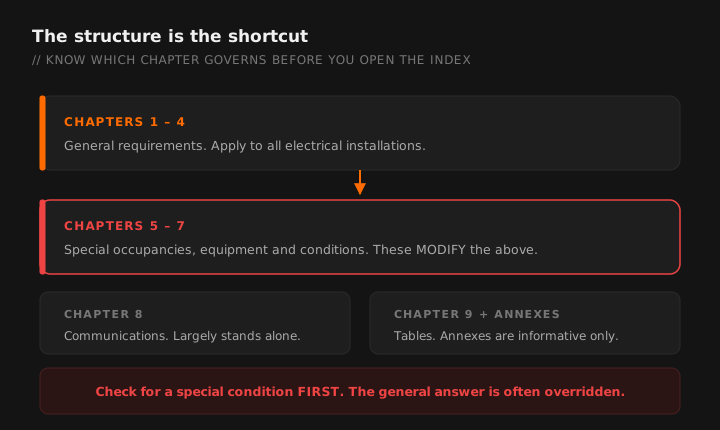
| Chapters | What they cover | How they interact |
|---|---|---|
| 1 through 4 | General requirements, wiring and protection, wiring methods and materials, equipment for general use | Apply to all electrical installations |
| 5, 6 and 7 | Special occupancies, special equipment, special conditions | Supplement or modify chapters 1 through 4 |
| 8 | Communications systems | Largely stands alone; other chapters apply only where specifically referenced |
| 9 | Tables | Referenced from the other chapters |
| Annexes | Informative material, examples, calculation aids | Not enforceable requirements |
This is the trap that produces confidently wrong answers. Somebody looks up a general requirement in Chapter 3, finds a clean answer, and stops. But the installation is in a hazardous location, or a health care facility, or a swimming pool area, and Chapter 5 modified that rule two hundred pages later. Always ask whether a special condition applies before you accept the general answer.
Speak the code's vocabulary
The index is built on defined terms. If you search your words instead of the code's, you will conclude the index is broken. It is not; you are.
| What you say | What the code says |
|---|---|
| Plug, outlet | Receptacle, receptacle outlet |
| Panel, breaker box | Panelboard, or the enclosure containing it |
| Breaker | Overcurrent protective device, circuit breaker |
| Ground wire | Equipment grounding conductor, or grounding electrode conductor |
| Neutral | Grounded conductor |
| Hot | Ungrounded conductor |
| Light | Luminaire |
| Pipe, conduit | Raceway, or the specific type |
| Wire | Conductor |
| Disconnect | Disconnecting means |
Type the question the way you would say it out loud and the app finds the section.
Learning those ten pairs does more for your lookup speed than any amount of memorizing article numbers.
The distinction that matters most: "outlet" is any point where current is taken to supply utilization equipment. A receptacle is one kind of outlet. A lighting outlet is another. When the code says outlet it usually means more than you think.
Index versus table of contents
Both are useful, for different questions.
Use the index when you know the object
You are looking at a thing: a receptacle in a garage, a disconnect at a rooftop unit, a bonding jumper. The index lists objects and their qualifiers, and it will take you straight there.
Use the table of contents when you know the subject
You know it is a grounding question but you do not know which specific requirement you need. The table of contents shows you the whole structure of Article 250 in one page, and you can see which part addresses your situation.
Use both, in that order
Experienced candidates try the index first, and if the entry is too broad or too narrow, they flip to the table of contents for the relevant article and scan its parts. That two-step is faster than either method alone.
The five-step method
- Translate the question into code language. "Do I need a GFCI for the plug in the garage" becomes "GFCI protection requirements for receptacle outlets in a dwelling unit garage."
- Decide which chapter governs. General installation? Chapters 1 through 4. Special occupancy, equipment or condition? Chapters 5 through 7 will modify it.
- Check for the special condition first. This is out of order deliberately. If a Chapter 5 through 7 rule applies, it overrides, and finding it first saves you from a wrong answer.
- Locate the section. Index for objects, table of contents for subjects.
- Read to the end of the section. Including every exception and every subsection. Requirements are routinely reversed or expanded a few lines down.
Exceptions and informational notes
Two kinds of text that look like requirements and are not, or are not quite.
Exceptions are permitted alternatives to the rule immediately preceding them. They are enforceable, and they only apply within their stated conditions. Missing one means doing more work than the code requires.
Informational notes are explanatory and are not enforceable requirements. The commonly quoted voltage drop percentages live in informational notes, which is why voltage drop is a design requirement rather than a code violation in most cases. A specification or an AHJ can make the same figure contractual, which is a different mechanism.
Read Article 90 once
Ten minutes, one time, and it will save you hours over a career. Article 90 covers the code's scope, how it is arranged, what the mandatory versus permissive language means, how exceptions and informational notes work, and what the code is and is not intended to be.
Most people skip it because it is not a requirement about wiring. It is the instruction manual for the book you are about to use for the next thirty years.
Practical habits
- Tab the book, if your board permits it. Tab by article, not by page. Verify the rules for your exam first, because tab violations can void a test.
- Drill navigation, not memorization. Set a timer and find twenty random requirements. Track the time. It drops fast.
- Learn the tables by location. 310.16 for ampacity, 250.66 for GEC, 250.122 for EGC, Chapter 9 for raceway and conductor properties, Annex C for same-size conduit fill. Knowing which table answers which question eliminates most searching.
- Note your own misses. Every time a lookup takes too long, write down what you searched and what the answer actually was. That list becomes your personal index.
- Confirm the edition. Section numbers move between editions, sometimes dramatically. Article 220 and much of Chapter 2 were reorganized recently. Check which edition applies to you before you memorize a number.
Where an app fits, and where it does not
A lookup tool is good at the translation step. Describe the situation in plain language and it points you at the requirement, skipping the vocabulary problem entirely. That is a real time saver in the field.
What it does not do is replace reading the section. Any tool, ours included, gives you guidance. The adopted code text and your AHJ are the authorities, and anything with money or an inspection on the line gets verified against the book. See our honest comparison of electrician apps for where each type of tool actually helps.
If you are studying for a license, the navigation drills matter more than the tool. See the journeyman practice questions and master practice questions to find out how fast you actually are.
Describe the situation and get the relevant requirement in seconds. Free tier.
GET THE FIELD PACK
Two printables: the 22-point rough-in checklist, and branded panel schedules in 24, 30 and 42 circuit that print at 4 by 5 inches and slide straight into a panel sleeve. Enter your email and the downloads open right away.
You're set. Both are below.
Your address comes straight to Jason. No list rental, no spam, unsubscribe any time.