The master exam is not a harder journeyman exam. It is a different exam. Journeyman tests whether you can install to the code. Master tests whether you can design to it and administer a job under it, which means load calculations, service and feeder design, coordination, and in most jurisdictions a business and law section.
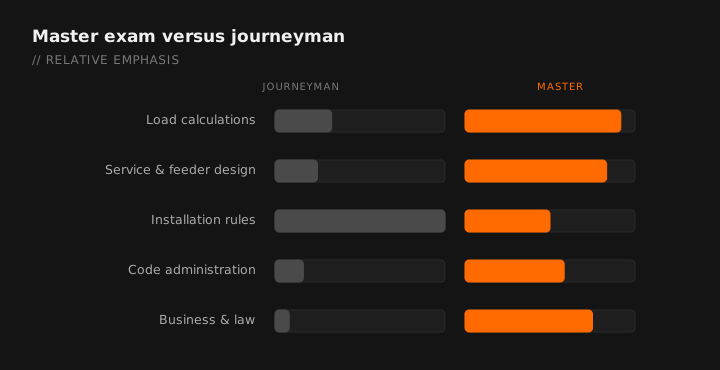
The questions below reflect that shift. Fewer lookups, more multi-step calculations, more questions that require combining two or three articles to get one answer. Tap any card to reveal the answer and the reference.
Before you start: confirm which NEC edition your licensing board tests to. It is frequently not the edition your state enforces for permits. These questions reflect long-standing requirements that have been stable across recent editions, but verify anything you plan to rely on.
Load calculations
Answer: 7,800 VA (2,600 sq ft × 3 VA per sq ft)
NEC Article 220, dwelling unit general lighting
Answer: 7,095 VA. First 3,000 at 100% = 3,000. Remaining 11,700 at 35% = 4,095. Total 7,095 VA.
NEC Article 220 dwelling unit demand factor table
Answer: 11,000 VA only. Heating and cooling are noncoincident; include the larger and omit the smaller.
NEC Article 220, noncoincident loads
Answer: 75%, because four or more such appliances are present. 9,600 × 0.75 = 7,200 VA.
NEC Article 220, fastened-in-place appliance demand
Answer: 41,300 ÷ 240 = 172.1 amperes, requiring a 200 ampere service.
NEC 240.6(A) standard ratings
Services and feeders
Answer: Six. Recent editions additionally require that each be in a separate enclosure with a main service disconnect, or otherwise meet the specific grouping provisions.
NEC 230.71
Answer: One third.
NEC 240.21(B)(2)
Answer: Not less than one tenth of the rating of the overcurrent device protecting the feeder, and not less than the rating of the device supplied.
NEC 240.21(B)(1)
Answer: 3 feet. That is Condition 1 for the 151 to 600 volt range.
NEC Table 110.26(A)(1)
Answer: Width of 30 inches or the width of the equipment, whichever is greater. Headroom of 6.5 feet or the height of the equipment, whichever is greater.
NEC 110.26(A)(2) and 110.26(A)(3)
Ask the app for the reasoning behind any answer instead of hunting the article number twice.
Overcurrent protection and motors
Answer: 68 × 1.25 = 85 amperes minimum, so a 90 ampere device with conductors rated at least 85 amperes at the applicable termination temperature.
NEC 210.19 and 210.20 continuous load provisions
Answer: 125 percent, using the full-load current from the NEC motor tables rather than the nameplate.
NEC 430.22 and 430.6(A)
Answer: 250 percent, with permission to increase further where necessary for starting, subject to the stated limits.
NEC Table 430.52
Answer: Because that device provides short-circuit and ground-fault protection only. Overload protection of the motor and conductors is provided separately by the overload device.
NEC Article 430, Parts III and IV
Answer: 25 percent of the full-load current of the largest motor in the group.
NEC 430.24
Grounding and bonding
Answer: 2 AWG copper. The row covers over 3/0 through 350 kcmil.
NEC Table 250.66
Answer: 6 AWG copper. The conductor to a rod, pipe or plate electrode is not required to be larger than 6 AWG regardless of the table value.
NEC 250.66(A)
Answer: 3 AWG copper.
NEC Table 250.122
Answer: Table 250.66 sizes the GEC from the size of the service-entrance conductors. Table 250.122 sizes the EGC from the rating of the overcurrent device.
NEC 250.66 and 250.122
Conductors and raceways
Answer: Ambient correction of 0.91 for a 90 degree C conductor at 36 to 40 degrees C, and an adjustment factor of 70 percent for 7 to 9 conductors. Both are applied to the table ampacity, and the result is then limited by the termination temperature rating.
NEC Table 310.15(B)(1) and Table 310.15(C)(1)
Answer: 31 percent. Two round conductors in a round raceway leave geometry that increases the risk of jamming during a pull.
NEC Chapter 9, Table 1
Answer: 60 percent fill is permitted, and the adjustment factors do not apply to raceways not exceeding 24 inches.
NEC Chapter 9, Table 1, Note 4 and 310.15(C)(1)
Answer: 360 degrees total, including the bends at the outlet and fitting ends.
NEC 358.26 for EMT, with parallel provisions in each raceway article
Code administration
Answer: Chapter 5. Chapters 5, 6 and 7 supplement or modify the general requirements of Chapters 1 through 4 for special occupancies, equipment and conditions.
NEC 90.3
Answer: No. Informational notes are explanatory and are not enforceable requirements, though a job specification or the AHJ may make the same figure contractual.
NEC 90.5(C)
How to study for this exam
Three things separate candidates who pass from candidates who retake.
Practice calculations under a clock
The master exam is a time test disguised as a knowledge test. Work full load calculations start to finish with a timer running. Twenty complete calculations under time is worth more than a hundred hours of reading.
Learn the structure, not the numbers
You cannot memorize the code and you should not try. What you can memorize is where things live: which chapter governs, which article covers your equipment, and which table answers which question. See how to look up a section fast.
Do the journeyman set first
The fundamentals still appear on the master exam, and the journeyman question set is a faster way to find your weak spots than working full calculations you are not ready for.
After you pass, the work is not over. Most states require continuing education to keep the license, and a portion of it is usually code-update hours tied to whichever edition your state adopts next.
Ask any question in plain English and get the reasoning. Free tier, upgrade for more daily scans.
GET THE FIELD PACK
Two printables: the 22-point rough-in checklist, and branded panel schedules in 24, 30 and 42 circuit that print at 4 by 5 inches and slide straight into a panel sleeve. Enter your email and the downloads open right away.
You're set. Both are below.
Your address comes straight to Jason. No list rental, no spam, unsubscribe any time.