Continuing education is the part of licensing nobody thinks about until the renewal notice shows up. Then it is a scramble to find an approved class, and sometimes the discovery that the hours you took last year do not count.
The requirements vary enough by state that no article can give you your number. What every state shares is the same structure, and understanding the structure tells you what to go verify.
Your licensing board is the only authoritative source. Hours, cycles, approved providers and code-update requirements all change between cycles, and they change without much announcement. Everything below describes how these programs generally work, not what your state requires today.
The four things every CE requirement has
1. A renewal cycle
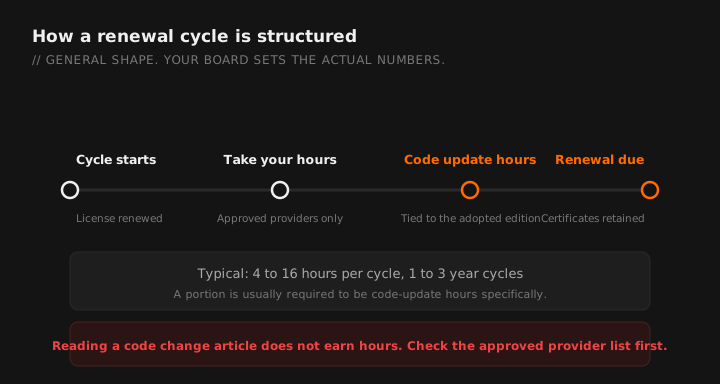
Typically one, two or three years. The cycle may be tied to a fixed calendar date for everyone, or to your individual license anniversary. That distinction matters more than it sounds: a fixed statewide date means every electrician in the state is looking for a class in the same six weeks, and seats fill.
2. A total hour count
Commonly somewhere between four and sixteen hours per cycle, varying by state and by license class. Masters frequently owe more hours than journeymen. A few states require none at all, and a few require substantially more than sixteen.
3. A code-update portion
This is the part that trips people. Many states require that a specific number of your hours be instruction on the changes in the newly adopted NEC edition, not general electrical training. Those hours usually cannot be satisfied by a safety class or a manufacturer training session, no matter how relevant.
Get ahead of the class with the code change breakdowns in the app and on this blog.
Because the code-update requirement is tied to whichever edition the state has adopted, your class content depends on where your state sits in the adoption cycle. A state that just moved from 2020 to 2023 will be running 2023 change classes, even though the 2026 edition is already published.
4. An approved provider list
Most states will not accept hours from just anyone. Providers apply for approval, courses are approved individually in some states, and the list is published by the board. Taking an excellent course from an unapproved provider earns you nothing.
Check the provider list before you register, not after. This is the single most common way electricians lose money on CE. The course was good, the instructor knew the material, and the board will not count it.
What generally counts
| Typically accepted | Often not accepted |
|---|---|
| Approved-provider NEC code update courses | Courses from providers not on the state list |
| State-specific law and rules instruction | Manufacturer product training, in many states |
| Approved safety training, where the state allows it | Trade show attendance |
| Union or apprenticeship program hours, where approved | Self-study without an approved assessment |
| Approved online courses, in most states | Reading a code change article, including this one |
That last row is worth being explicit about. Reading a summary of the code changes makes you better at your job and does not earn you a single hour. Use articles to arrive at the class already knowing the material, not to skip the class.
Online versus in person
Most states now accept online CE, and many accept it for the full requirement. Some cap the online portion, and a few still require in-person attendance for the code-update hours specifically.
Where online is permitted, the tradeoff is real:
- Online is cheaper, schedulable around work, and usually self-paced. It is also easy to click through without retaining anything, which defeats the purpose.
- In person costs more and costs a work day, but the instructors are usually working inspectors or contractors, and the questions from the room are frequently more valuable than the slides.
If your state adopted a new edition this cycle, the in-person class is worth the day. Local instructors know which changes your AHJ is enforcing aggressively and which they are not, and that information is not in any book.
Reciprocity, and its limits
States with reciprocity agreements may accept hours earned elsewhere, but almost always with a condition: the state-specific law and rules portion still has to be taken in that state. A code-update class covers the model code, which is the same everywhere. A state's own amendments and licensing law are not.
If you hold licenses in more than one state, map the cycles before you plan. Overlapping renewal dates with different requirements is a scheduling problem worth solving once rather than discovering annually.
Documentation
Keep certificates for at least one full cycle beyond the one they satisfied, and ideally longer.
- Many boards audit a percentage of renewals at random.
- Some providers report hours directly to the board, some do not, and some do it slowly.
- Provider record retention is not your problem until it is.
A folder on your phone with a photo of every certificate takes thirty seconds per class and closes the entire issue.
If you miss the deadline
Consequences scale with how far past you are:
- A grace period with a late fee in many states, if you catch it quickly.
- License lapse, meaning you cannot legally work under that license until it is reinstated. This one also affects your employer's ability to pull permits.
- Reinstatement requirements, which can include back CE hours, additional fees, and in some jurisdictions re-examination.
Re-examination is the outcome worth avoiding, because it means sitting the master or journeyman exam again on whatever edition the board currently uses.
How to make the requirement useful instead of a chore
The code-update class is the one piece of mandatory training that directly changes how you work, because it covers exactly the requirements your inspector is about to start enforcing. Two things make it worth more:
Read the changes before the class. Walk in already knowing the general shape and spend the class asking about the parts that affect your specific work. Our 2023 breakdown and 2026 breakdown are written for exactly this.
Ask the instructor about local enforcement. Which changes is your AHJ writing up, which are they easing into, and what amendments did the state adopt. That is the difference between knowing the code and knowing your jurisdiction.
The checklist
- Confirm your renewal date and whether it is fixed statewide or on your license anniversary.
- Confirm total hours required for your license class this cycle.
- Confirm how many of those must be code-update hours, and to which edition.
- Pull the current approved provider list from the board.
- Register early if your state uses a fixed statewide renewal date.
- Save every certificate, and keep them a full cycle longer than you think you need to.
Code updates explained in plain English, in the app. Free tier.
GET THE FIELD PACK
Two printables: the 22-point rough-in checklist, and branded panel schedules in 24, 30 and 42 circuit that print at 4 by 5 inches and slide straight into a panel sleeve. Enter your email and the downloads open right away.
You're set. Both are below.
Your address comes straight to Jason. No list rental, no spam, unsubscribe any time.