There is no single national start date for the 2026 edition of the National Electrical Code (NFPA 70). It becomes enforceable state by state, as each one adopts it. As of late September 2026 it is in force in eight states: Arkansas, Colorado, Maine, Massachusetts, Minnesota, North Dakota, Texas and Wyoming. Massachusetts went first in April, and Texas and Arkansas switched in early September. Oregon and Washington are in rulemaking for late 2026. Most of the country is still on 2023, and some states are further back than that. The state-by-state adoption table has every state.
Whether your state switched this year or you're still working under the 2023 cycle, these changes are coming. If you're studying for your journeyman or master exam, expect questions based on the 2026 edition to start appearing soon.
This article covers the changes that matter most to working electricians, ranked from highest daily impact to more specialized updates. Let's get into it.
High Impact
1. Major Code Reorganization — The Book Has Moved
This is the single biggest change in the 2026 NEC — not because the requirements themselves are radically different, but because the code sections you've memorized are in different places now. If you're used to flipping to Article 220 for load calculations or Article 750 for energy management, those articles have moved.
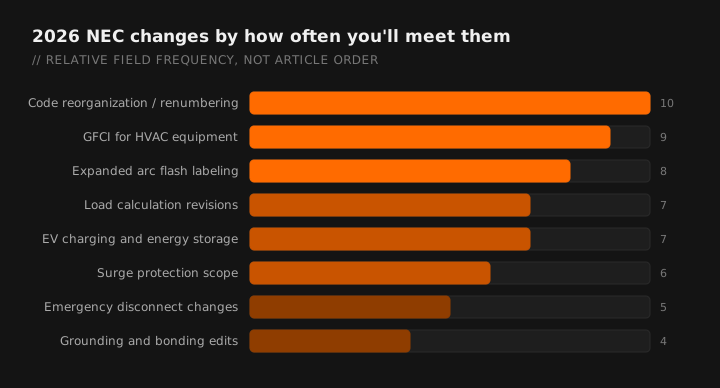
Here's what moved and where it went:
- Load Calculations — Article 220 is now Article 120 (moved to Chapter 1, General Requirements)
- Energy Management Systems — Article 750 is now Article 130 (also moved to Chapter 1)
- Limited-Energy & Communications — consolidated into Chapter 7, Articles 720–760 (Chapter 8 is being absorbed)
- Snap Switches — moved from Article 404 to Article 406 (now grouped with all wiring devices)
- Article 404 — now covers only disconnect switches, motor circuit switches, and heavy-duty switchgear
- Five new medium-voltage articles — Articles 245, 265, 266, 267, 268, 270 added to Chapter 2
High Impact
2. Load Calculation Overhaul — Article 120
The load calculation changes in the 2026 NEC are substantial and will affect how you size every residential service and feeder going forward. The key changes:
Dwelling Unit General Lighting Reduced to 2 VA/ft²
The general lighting and general-use receptacle load for dwelling units has been reduced from 3 VA per square foot to 2 VA per square foot for feeder and service calculations. This is a 33% reduction that reflects the widespread adoption of LED lighting and more energy-efficient equipment. For a 2,000 sq ft home, that's a reduction from 6,000 VA to 4,000 VA in the lighting load alone.
Important distinction: Branch circuit calculations still use 3 VA/ft² per Section 120.13 to ensure the minimum number of branch circuits isn't reduced. Don't confuse the two.
125% Continuous Load Multiplier Removed from Load Calculations
Section 120.5(E) explicitly states that continuous loads are no longer calculated at 125% during the load calculation itself. The 125% factor may still apply when sizing conductors and overcurrent devices, but it's been removed from the load calculation step. This eliminates a common source of confusion and double-counting.
Demand Factors for Instantaneous Water Heaters
Look up any section from the 2017, 2020 or 2023 editions in plain English while you read.

Section 120.56 now allows demand factors for tankless/instantaneous water heaters when sizing feeders and services. Previously, these high-draw units were calculated at full nameplate, which often pushed service sizes higher than necessary. The new demand factors are based on the number of units connected.
EVSE Calculated at 100%, Not 125%
Under the new optional dwelling unit method, EV charger loads are calculated at 100% of nameplate — not 125%. Combined with Power Control Systems (Article 130), this can prevent costly service upgrades for homes adding EV charging.
Simplified Existing Dwelling Calculations
The two separate methods for existing dwelling unit calculations (with and without HVAC additions) have been merged into a single unified table (Table 120.83), simplifying the process significantly.
High Impact
3. GFCI Protection for Outdoor HVAC Equipment
This is the change that's going to affect the most residential installations immediately.
Starting September 1, 2026, all outdoor HVAC equipment serving dwelling units that operates at 208V or 240V single-phase, rated 50 amps or less, must have GFCI protection. The temporary exception for listed HVAC equipment expires on that date. After September 1, 2026, listed HVAC equipment can use Class C SPGFCI (Special Purpose Ground Fault Circuit Interrupter) protection with a trip threshold of 20mA instead of the standard Class A 5mA threshold.
Exception 2 expires September 1, 2026 — after that date, HVAC equipment must be GFCI protected.
Exception 3 allows Class C SPGFCI protection after September 1, 2026 for listed HVAC equipment.
Why HF-rated GFCIs matter: Modern inverter-driven and variable-speed HVAC equipment produces high-frequency leakage currents that can cause nuisance tripping on standard Class A GFCIs. HF-rated (High Frequency) GFCIs, now codified under UL 943, are designed to handle these frequencies without false trips. If you're installing GFCI protection on inverter-based HVAC systems, specify HF-rated devices.
Material impact: Every residential outdoor HVAC installation will require either a GFCI breaker, a GFCI disconnect, or listed SPGFCI protection. Factor this into your quotes — it's a new line item on every residential HVAC circuit.
High Impact
4. Arc Flash Labeling — 1,000A Threshold Removed
Under the 2023 NEC, arc flash hazard labeling was only required for service and feeder-supplied equipment rated above 1,000 amps in non-dwelling occupancies. The 2026 NEC eliminates the 1,000 amp threshold entirely.
This means all service and feeder-supplied equipment in commercial and industrial buildings — regardless of amperage — must now have arc flash hazard labels. A 200A panelboard in an office building now requires the same labeling as a 4,000A switchboard.
The labels must now include specific enforceable information:
- Nominal system voltage
- Arc flash boundary
- Required PPE information (either incident energy value in cal/cm² or PPE category)
- Date of the assessment
Field impact: More equipment needs arc flash studies and labels. This increases upfront engineering costs on commercial jobs but significantly improves worker safety. If you're maintaining or modifying existing commercial equipment, verify that labels are current — any change to fault current, protective device settings, or upstream configuration can invalidate existing labels.
Medium Impact
5. EV Charging Infrastructure Updates
EV infrastructure gets significant attention in the 2026 NEC with several practical changes:
- Emergency shutoffs are now required for EV chargers in commercial and public settings
- EVSE receptacles must be listed specifically for EV use — you can no longer install a standard NEMA 14-50 receptacle on a 40A circuit and call it an EV charging outlet
- GFCI protection is required for EV charging receptacles
- SPGFCI requirements apply to certain EV equipment where voltage-to-ground exceeds 150V (some provisions phase in through January 1, 2029)
- "Qualified person" language for installation of permanently installed EV power transfer equipment — widely expected to be interpreted as requiring licensed electricians in most jurisdictions
New Article 624 introduces requirements for Electric Self-Propelled Vehicle Power Transfer Systems (ESVSEs) — covering non-road vehicles like forklifts, AGVs, and other industrial EVs that are increasingly electrified.
Medium Impact
6. Emergency Disconnect Refinements
The emergency disconnect requirements for one- and two-family dwellings (first introduced in 2020, refined in 2023) get further clarification in 2026:
- Disconnect labels must now use standardized formatting: red background with white text reading "EMERGENCY DISCONNECT"
- Labels must be durable, not handwritten, and permanently attached
- Non-dwelling disconnect labels use "SERVICE DISCONNECT" instead
- When alternate energy sources (solar, battery, generator) are not co-located with the emergency disconnect, a plaque or directory identifying their disconnect locations is now required
- The service disconnect now also serves as the emergency disconnect — the requirements have effectively merged
Medium Impact
7. Limited-Energy Systems — Chapter 8 Absorbed Into Chapter 7
This is a major structural change that affects anyone working with low-voltage and communications systems. Chapter 8, which historically operated independently from the rest of the NEC, is being folded into Chapter 7.
The restructured Chapter 7 (Articles 720–760) now houses all primary installation requirements for limited-energy systems, including:
- Class 2 and Class 3 circuits
- Communications systems (formerly Chapter 8)
- Fire alarm systems
- CATV and broadband
- Power-limited and fault-managed systems
- Optical fiber systems
A new global definition for "limited-energy cable" has been added to Article 100, covering all these system types under one umbrella term.
The 2029 NEC is expected to complete this transition with further clean-up. For now, expect inspectors to reference Chapter 7 for systems that you may be used to finding in Chapter 8.
Specialized
8. Medium-Voltage Articles Reorganized
The 2026 NEC adds five new articles to Chapter 2 specifically for systems over 1000V AC / 1500V DC:
- Article 245 — Overcurrent Protection (over 1000V AC/1500V DC)
- Article 265 — Branch Circuits
- Article 266 — Feeders
- Article 267 — Outside Branch Circuits and Feeders
- Article 268 — Services
- Article 270 — Grounding and Bonding
These articles mirror the structure of their low-voltage counterparts, making it easier to find medium-voltage requirements without digging through scattered sections. Medium-voltage equipment must now also be listed or field-evaluated.
This primarily affects commercial, industrial, and utility-scale work. If your work stays below 600V, these changes won't impact your daily installations — but if you're studying for your master exam, expect questions about the new article numbers.
Lower Impact
9. Raceway and Wiring Method Clarifications
Several practical clarifications that fix long-standing ambiguities:
360° Bend Limit Clarified Across Wiring Methods
The rule limiting bends to 360° between pull points has always been in individual raceway articles (like 358.26 for EMT). But technically, if you transitioned from RMC to IMC mid-run, you could argue each raceway type got its own 360°. The 2026 NEC closes this loophole — the 360° limit now applies to the entire run between pull points regardless of raceway types used.
Welding Raceways Is Now Prohibited — No Exceptions
Previous editions allowed welding raceways if "allowed elsewhere" in the code (there was no such allowance) or if "specifically designed to be welded." The 2026 NEC removes these vague exceptions — welding raceways is now prohibited, period.
Indoor Wet Location Raceways Must Drain
Outdoor raceways in wet locations have always been required to be arranged to drain. Indoor wet locations now have the same requirement. Use enclosures with weep holes or listed drainage fittings.
Locknuts Required on Both Sides of Enclosures
When threaded conduit enters an enclosure through an opening without female threads, a locknut or fitting must be installed on both sides of the enclosure. The NEC now explicitly requires this, ending the debate about whether two or four locknuts were needed on a conduit run between two enclosures.
Cable Tray Stacking — 12" Minimum Clearance
Stacked cable trays must now maintain a minimum 12-inch clearance between trays, requiring advance planning of tray elevations during design.
Lower Impact
10. Additional Changes Worth Knowing
Surge Protection in Sleeping Quarters
Surge protective devices are now required in sleeping quarters of non-dwelling occupancies — think dormitories, fire stations, and barracks. This extends the surge protection requirements beyond single-family dwellings.
Power Control Systems (PCS) — New Article 130
PCS allow managed electrical loads to be factored into load calculations, potentially preventing service upgrades. PCS control settings must not exceed 80% of the overcurrent protective device rating. This is significant for facilities adding EV charging or other large loads to existing services.
Outdoor Outlet GFCI Threshold Increased to 60A
Section 210.8(F) increases the GFCI protection requirement for outdoor outlets from circuits rated 50A to 60A or less.
Kitchen Countertop Receptacle Placement
Section 210.52(A)(5) now prohibits receptacle outlets from being installed below or within 24 inches below the countertop surface in kitchens. This addresses the common (and annoying) practice of installing receptacles in locations that are technically compliant but practically useless.
Dock and Pier Ground Fault Protection
Ground fault protection for docking facilities now covers both branch circuits and feeders, with protection rated at 100mA or less. Commercial dock installations also now require engineered electrical design documentation to be provided to the AHJ.
Hazardous Location Bonding Consolidated
Bonding requirements previously spread across Articles 501, 502, and 503 have been consolidated into Article 500 for easier reference.
Working Space Egress Clarified
The NEC now specifies a defined 24-inch egress path at a 90-degree door opening for electrical equipment rooms, which may influence electrical room layout and equipment placement during the design phase.
What This Means for You
The 2026 NEC is a code cycle that demands retraining, not just awareness. The structural reorganization alone means your familiar article numbers have changed — and on an open-book exam or during an inspection, finding the right section quickly is half the battle.
For residential electricians: the GFCI requirement for outdoor HVAC, the load calculation changes (2 VA/ft², simplified existing dwelling calcs, EVSE at 100%), and the standardized emergency disconnect labeling will hit your daily work immediately.
For commercial electricians: the arc flash labeling expansion is the big one. Every piece of service and feeder-supplied equipment in non-dwelling occupancies needs labels now, regardless of size. The EV charging updates and medium-voltage reorganization also affect commercial and industrial work.
For exam candidates: expect the new article numbers (especially Article 120 for load calculations and Article 130 for EMS), the GFCI/HVAC changes, the arc flash expansion, and the 2 VA/ft² reduction to be heavily tested. Know where things live in the 2026 code — navigation speed wins exams.
Ask any code question in plain English and get an answer in seconds. Free tier, no card required.
GET THE FIELD PACK
Two printables: the 22-point rough-in checklist, and branded panel schedules in 24, 30 and 42 circuit that print at 4 by 5 inches and slide straight into a panel sleeve. Enter your email and the downloads open right away.
You're set. Both are below.
Your address comes straight to Jason. No list rental, no spam, unsubscribe any time.