These two devices look similar, install similarly, and cost about the same. They protect against completely different things, and neither substitutes for the other. Understanding the difference is the fastest way to stop guessing at required locations.
What each one detects
| GFCI | AFCI | |
|---|---|---|
| Protects against | Electrocution | Fire |
| Detects | Current leaking to ground | The electrical signature of an arcing fault |
| Trip threshold | A few milliamperes of imbalance | Pattern recognition, not a fixed current |
| Trip speed | Milliseconds | Milliseconds once the pattern is confirmed |
| Typical location driver | Water and grounded surfaces | Habitable rooms and concealed wiring |
How a GFCI works
It measures the current going out on the ungrounded conductor and the current coming back on the grounded conductor. In a healthy circuit those match. If a few milliamperes are going somewhere else, the most likely somewhere else is a person, and the device opens.
That is why a GFCI works fine with no equipment grounding conductor present. It is not comparing anything to ground; it is comparing the two circuit conductors to each other.
How an AFCI works
Arcing produces a distinctive, chaotic current waveform, different from the clean signature of a motor starting or a switch closing. The AFCI watches for that pattern and opens when it sees it. It is doing signal analysis rather than measuring a threshold, which is why AFCI behavior is harder to predict than GFCI behavior.
Where GFCI protection is required
In dwelling units, the required locations have expanded in every recent code cycle. The general shape, subject to your adopted edition:
- Bathrooms
- Garages and accessory buildings with a floor at or below grade and not intended as habitable rooms
- Outdoors
- Crawl spaces at or below grade
- Basements, with recent editions covering all areas rather than only unfinished portions
- Kitchens, for receptacles serving countertop surfaces and, in recent editions, more broadly
- Within a specified distance of a sink, wherever that sink is
- Laundry areas
- Boathouses, bathtub and shower areas, indoor damp and wet locations
Check the required locations for the edition your AHJ actually enforces, in the app.
The 2023 change that catches people: GFCI protection was extended to 240-volt receptacle outlets in the required locations, and specific appliance provisions were added. That brings ranges, dryers and similar equipment into scope in a way they never were before. Whether it applies to your job depends entirely on which edition your jurisdiction has adopted.
Where AFCI protection is required
In dwelling units, AFCI protection covers branch circuits supplying outlets and devices in essentially all habitable rooms:
- Kitchens, family rooms, dining rooms, living rooms, parlors, libraries and dens
- Bedrooms, sunrooms, recreation rooms and closets
- Hallways, laundry areas and similar rooms or areas
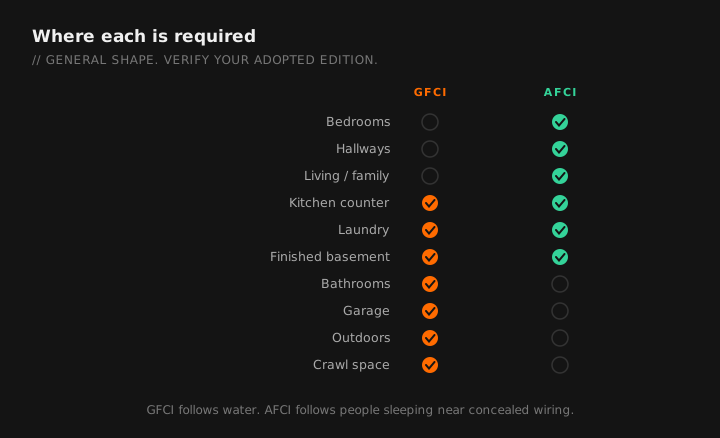
The practical summary for a modern dwelling is that AFCI covers almost everything except bathrooms, garages, unfinished basements and outdoors, which is roughly the inverse of the GFCI list. That inversion is not a coincidence: GFCI follows water, AFCI follows people sleeping near concealed wiring.
Where you need both
The two lists overlap in kitchens and laundry areas, and recent editions have expanded that overlap. This is why dual-function devices exist and why they now make up a growing share of what a supply house sells.
| Location | GFCI | AFCI |
|---|---|---|
| Bedroom receptacles | Generally no | Yes |
| Bathroom receptacles | Yes | Generally no |
| Kitchen countertop | Yes | Yes |
| Laundry area | Yes | Yes |
| Unfinished basement | Yes | Generally no |
| Finished basement living space | Recent editions | Yes |
| Garage | Yes | Generally no |
| Outdoors | Yes | Generally no |
| Hallway | Generally no | Yes |
Treat this table as a planning aid, not as a code citation. The specific requirements, exceptions and the treatment of individual appliance outlets vary by edition, and your AHJ's amendments can change any row.
Nuisance tripping, and what actually causes it
AFCI complaints are common, and the breaker is usually not the problem. In rough order of likelihood:
1. Shared neutrals
By a wide margin the most common cause. If two circuits share a neutral somewhere in the building, the AFCI sees current returning that does not match what it sent, and it treats that as a fault. This is most common in older homes and in remodels where somebody tied neutrals together in a box to save a wire.
2. Wiring errors at devices
A neutral landed on the wrong side of a device, a switch loop wired without a neutral, or a backstab connection that is arcing slightly under load.
3. Actual arcing faults
Sometimes the device is right. A damaged cable behind drywall, a nail through a cable during trim, or a failing connection in a device. Before you assume nuisance, consider that the device is doing its job.
4. Noisy loads
Certain motors, older dimmers, and some switching power supplies produce signatures close enough to arcing to trigger a trip. Modern AFCI designs have improved substantially here, but it still happens.
Diagnostic order: disconnect the load and see if it holds. If it holds, the load is implicated. If it still trips with nothing connected, you have a wiring problem, and shared neutrals are where to look first.
Device versus breaker
| Receptacle device | Breaker | |
|---|---|---|
| Cost | Lower per point | Higher per circuit |
| Protects | Itself and downstream loads on the load terminals | The entire circuit including the wiring |
| Reset access | At the device, which may be behind an appliance | At the panel |
| Best for | A single location, or retrofits | Whole circuits, and anywhere the wiring itself matters |
Where the goal is protecting the branch circuit wiring, which is the entire point of AFCI, the breaker is generally the right answer. Where the goal is protecting a person at a specific outlet, either works, and cost usually decides it.
Testing and maintenance
Both device types have test buttons and both are supposed to be tested periodically. Recent editions require that GFCI devices be of the self-test type, which addresses the fact that essentially nobody was pushing the button monthly.
A GFCI that will not trip on its test button is a failed device and gets replaced. A GFCI that trips but will not reset is telling you something about the circuit.
The trend line
Every recent cycle has expanded both. The edition history shows GFCI moving steadily from a handful of wet locations to most of a dwelling, and AFCI from bedrooms only to nearly all habitable space. There is no reason to expect that to reverse.
Which means the practical advice is the same as it is everywhere else in this code: confirm your adopted edition before you lay out the panel, because the layout you learned five years ago is probably no longer sufficient. See the 2023 changes and the 2026 changes for the specifics of each cycle.
2017, 2020 and 2023 side by side in the app. Free tier, works offline.
GET THE FIELD PACK
Two printables: the 22-point rough-in checklist, and branded panel schedules in 24, 30 and 42 circuit that print at 4 by 5 inches and slide straight into a panel sleeve. Enter your email and the downloads open right away.
You're set. Both are below.
Your address comes straight to Jason. No list rental, no spam, unsubscribe any time.