There is a question that decides whether your work passes or fails, and it is not in any code book: which edition does the inspector standing in front of you actually enforce?
The National Electrical Code is a model code. NFPA writes it and publishes a new edition every three years, but NFPA has no authority to make anyone follow it. It becomes law only when a state, county or city adopts it through its own legal process. That process runs on political calendars, budget cycles and code board meetings, which is why the country is a patchwork instead of a single edition.
Get this wrong and you find out at the worst possible moment: material already on the job, drywall scheduled, and an inspector telling you the requirement you designed to has not been adopted here yet.
Publication is not adoption
NFPA published the 2026 edition on October 10, 2025. That date matters for the printing schedule and almost nothing else. Historically, states take anywhere from twelve months to five years to adopt a new edition, and some skip editions entirely to catch up later.
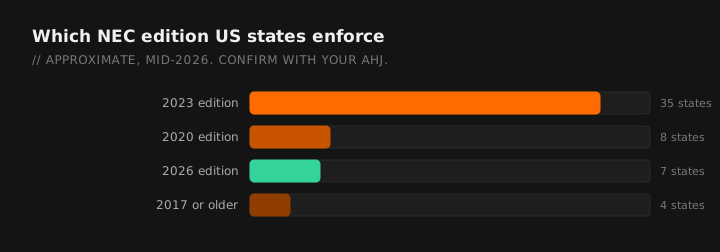
As of the middle of 2026, the picture looks roughly like this:
- A small group of states have completed adoption of the 2026 edition. Several of these are the fast-moving western and New England states that historically adopt early.
- The large majority are still enforcing the 2023 edition. If you had to guess blind which code governs a random American job site today, 2023 is the correct guess.
- A handful remain on 2020 or older. A couple of jurisdictions are further back than that, in some cases by a decade or more.
- Some large cities maintain their own electrical code entirely and do not track the NEC edition their state adopted at all.
The app carries 2017, 2020 and 2023 together, so you can check the edition that governs the job you are on.
Any published adoption table, including this one, is a snapshot. States complete adoptions throughout the year and local jurisdictions move independently. Treat every tracker you find online as the starting point for a phone call, never as the answer.
Why the lag exists
People assume the delay is bureaucratic laziness. Usually it is not. There are three real reasons.
Rulemaking takes time by design
Adopting a code is a rulemaking action in most states. That means public notice, a comment period, hearings, and often a legislative or board vote. Building the record properly takes months even when nobody objects.
Amendments are negotiated
Many states do not adopt the NEC clean. They adopt it with amendments that delete, modify or add requirements based on local conditions, industry input and cost concerns. Each amendment is argued. The AFCI and GFCI expansions in recent cycles have been amended out or delayed in more than one state on cost grounds.
Adoption is bundled
The electrical code frequently rides along with the rest of the building code family on a single adoption cycle. If the mechanical or energy code is contentious, the electrical code waits with it.
The four-step method for confirming your edition
This is the sequence I use before designing or bidding anything in an unfamiliar jurisdiction. It takes about fifteen minutes.
1. Start with the state
Find the state's adopted electrical code through the licensing board, the building code council, or the state fire marshal's office. This is your baseline. Some states publish it plainly; others bury it in an administrative code citation.
2. Find the amendments
The amendment document is separate from the code book and is exactly as enforceable. This is the step most people skip, and it is where the surprises live. An amendment can delete a requirement you were counting on or add one that is not in the model code at all.
3. Check the local jurisdiction
Cities and counties can adopt a different edition than the state or add local amendments on top. The permit office is the authority here, not the state website.
4. Confirm with the AHJ in writing
Call or email the inspection office and ask which edition and which amendments apply to permits pulled today. Save the reply. On a disputed inspection, a written answer from that office outweighs any tracker, any book and any app.
Bidding across state lines? Confirm the edition before you price the job, not after you win it. The difference between 2020 and 2023 GFCI requirements alone can move material and labor on a residential package by a real number.
What actually changes between editions
The differences that bite are rarely exotic. Across the last several cycles, the same handful of areas keep moving:
| Area | Direction of travel | Why it matters on a bid |
|---|---|---|
| GFCI locations | Expanding every cycle, including to 240-volt appliance outlets | Device cost and panel space on residential |
| AFCI coverage | Expanding, with some state amendments pushing back | Breaker cost, callback risk from nuisance tripping |
| Surge protection | Required at more services each cycle | Added device at every dwelling service |
| Emergency disconnects | Broadened for one- and two-family dwellings | Exterior equipment and labeling |
| EV and energy storage | New and expanding articles | Load calculations and service capacity |
If you want the specifics rather than the direction, the 2023 breakdown and the 2026 breakdown go article by article, and the edition history traces all of it back to 2008.
Adoption for licensing is a separate question
Here is the trap that catches exam candidates. The edition your state adopted for enforcement and the edition your licensing board writes the exam to are frequently not the same edition.
Boards update their exam banks on their own schedule. It is common to find a state enforcing the 2023 edition while the journeyman exam is still written to 2020, or occasionally the reverse. Buying the wrong code book for a test you paid for is an expensive way to learn this.
Ask the board directly, in writing, before you buy anything. The same goes for continuing education hours, where code-update classes are usually tied to the newly adopted edition specifically.
What to do when the editions disagree in your favor
Sometimes a newer edition relaxes something. A requirement gets an exception, or a rule you have been complying with gets narrowed. If your jurisdiction has not adopted that edition, you do not get the relaxation. The adopted edition governs, full stop.
The reverse is generally fine. Installing to a newer, stricter requirement than your jurisdiction has adopted is almost always acceptable, because you are exceeding the minimum. Where it gets complicated is when a newer requirement conflicts with an older one rather than simply tightening it. That is an AHJ conversation, not a judgment call you make on the tailgate.
The short version
The NEC is not the law until someone makes it the law. Which edition governs your job depends on your state, your state's amendments, your local jurisdiction, and your local jurisdiction's amendments, in that order of increasing authority. Fifteen minutes of confirmation up front is worth more than any table you will find online, including this one.
2017, 2020 and 2023 in your pocket, offline. Ask any section in plain English. Free to start.
GET THE FIELD PACK
Two printables: the 22-point rough-in checklist, and branded panel schedules in 24, 30 and 42 circuit that print at 4 by 5 inches and slide straight into a panel sleeve. Enter your email and the downloads open right away.
You're set. Both are below.
Your address comes straight to Jason. No list rental, no spam, unsubscribe any time.