⚠️ This article is for educational reference only. Always follow your employer's safety program, site-specific procedures, and the current edition of NFPA 70E. Arc flash hazards can cause severe injury or death.
What Is Arc Flash?
An arc flash is an explosive release of energy caused by an electrical arc between conductors or between a conductor and ground. The temperatures at the arc point can exceed 35,000°F — roughly four times the surface temperature of the sun. The blast produces intense heat, blinding light, pressure waves, shrapnel from molten metal, and toxic gases.
Arc flash events happen fast — typically in fractions of a second — but the consequences are devastating: severe burns, hearing damage, blindness, lung damage from vaporized metal, and death. According to OSHA and industry data, approximately 2,000 workers are sent to burn centers each year due to arc flash injuries in the United States.
NFPA 70E: The Standard for Electrical Safety
While the NEC (NFPA 70) covers how to install electrical systems, NFPA 70E covers how to work safely around them. It's the standard for electrical safety in the workplace, and OSHA references it as the basis for citing employers who fail to protect workers from electrical hazards.
NFPA 70E establishes the requirements for risk assessment, approach boundaries, PPE selection, energized work permits, and lockout/tagout procedures. Every electrician should be familiar with its key provisions.
The Hierarchy of Risk Controls
NFPA 70E follows a hierarchy of risk controls, and the most important principle is simple: de-energize first. Working on energized equipment should only happen when de-energizing creates a greater hazard or when the task is infeasible with the equipment de-energized (like voltage testing or thermography).
PPE categories and boundary distances live in the app's reference library. No signal needed.

- Elimination: De-energize the equipment (always the first choice)
- Substitution: Use safer equipment or methods
- Engineering controls: Remote operation, insulated tools, barriers
- Awareness: Warning signs, labels, barricades
- PPE: The last line of defense, not the first
Approach Boundaries
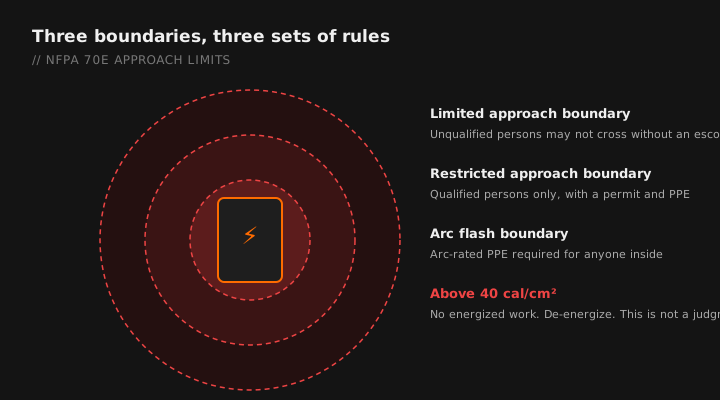
NFPA 70E defines three approach boundaries around energized equipment. Each boundary has different requirements for who can enter and what protection they need.
| Boundary | Description | Who Can Enter |
|---|---|---|
| Limited Approach | Outer boundary — approaching closer than this requires training | Qualified persons only (or unqualified escorted by qualified) |
| Restricted Approach | Closer boundary — risk of shock increases significantly | Qualified persons with appropriate PPE and a documented plan |
| Arc Flash Boundary | The distance where incident energy equals 1.2 cal/cm² — enough to cause a second-degree burn on exposed skin | Qualified persons wearing appropriate arc-rated PPE |
The exact distances vary based on the voltage level and the specific equipment. NFPA 70E Table 130.4(E)(a) provides approach boundaries for AC systems based on voltage.
PPE Categories
When arc flash PPE is required, NFPA 70E uses a category system based on incident energy levels. The higher the category, the more protection required.
| PPE Category | Min Arc Rating | Typical PPE |
|---|---|---|
| Category 1 | 4 cal/cm² | Arc-rated long-sleeve shirt, pants, safety glasses, hearing protection, leather gloves |
| Category 2 | 8 cal/cm² | Arc-rated shirt and pants (or coverall), arc-rated face shield, hard hat, hearing protection, leather gloves |
| Category 3 | 25 cal/cm² | Arc flash suit hood, arc-rated shirt, pants, and jacket, hard hat, hearing protection, rubber insulating gloves with leather protectors |
| Category 4 | 40 cal/cm² | Full arc flash suit with hood, multi-layer arc-rated clothing, rubber insulating gloves with leather protectors, arc-rated hard hat |
⚠️ If the incident energy exceeds 40 cal/cm², the equipment must NOT be worked on while energized. No commercially available PPE provides adequate protection above this level. De-energize the equipment — there is no exception.
Incident Energy Analysis vs. PPE Category Method
NFPA 70E provides two methods for determining the required PPE:
Incident Energy Analysis: An engineering study calculates the exact incident energy (in cal/cm²) at a specific working distance for each piece of equipment. This is the more precise method and is typically performed by an engineer. The results are printed on arc flash labels affixed to the equipment.
PPE Category Method (Table Method): NFPA 70E Table 130.7(C)(15)(a) and (b) assign PPE categories based on equipment type and parameters (like available fault current and clearing time). This is the simpler method and is commonly used when a detailed incident energy study hasn't been performed.
Both methods are acceptable under NFPA 70E, but you cannot mix them for the same piece of equipment — choose one and stick with it.
Energized Electrical Work Permits
When work must be performed on energized equipment, NFPA 70E requires an Energized Electrical Work Permit (EEWP). This permit must document why the equipment cannot be de-energized, the shock and arc flash hazard assessment results, the safe work practices to be used, the PPE required, and the approval of the responsible manager.
An EEWP is not required for tasks like voltage testing, thermography, and visual inspections that do not involve interaction with the equipment, provided appropriate PPE is worn.
Lockout/Tagout (LOTO)
The foundation of electrical safety is establishing an electrically safe work condition. NFPA 70E Article 120 outlines the process:
- Identify all sources of energy
- Disconnect/open the disconnecting means
- Apply lockout/tagout devices
- Verify the absence of voltage (test before you touch)
- Release stored energy (capacitors, springs, etc.)
- Apply temporary protective grounding if required
Test before you touch is the most critical step. Never assume a circuit is de-energized because someone flipped a breaker. Verify it yourself with a properly rated voltage tester — and verify that your tester is working on a known live source before and after testing.
Key Takeaways
- De-energize first. Always. Working energized is the last resort, not the default.
- Read the arc flash label before opening any panel or enclosure. It tells you the incident energy, the required PPE category, and the arc flash boundary.
- Wear the right PPE. A cotton t-shirt and safety glasses are not arc-rated. Synthetic fabrics (polyester, nylon) can melt to your skin in an arc flash event.
- Test before you touch. Every time. No exceptions.
- Your employer is required to provide arc flash training, PPE, and a documented electrical safety program. If they don't, that's an OSHA violation.
PPE categories, approach boundaries and incident energy references, offline and field-ready.
GET THE FIELD PACK
Two printables: the 22-point rough-in checklist, and branded panel schedules in 24, 30 and 42 circuit that print at 4 by 5 inches and slide straight into a panel sleeve. Enter your email and the downloads open right away.
You're set. Both are below.
Your address comes straight to Jason. No list rental, no spam, unsubscribe any time.