Box fill is the calculation everybody thinks they know and a lot of people quietly get wrong. It is not complicated math. It is a counting problem with rules that are not intuitive, and the rules are where the failures come from.
The requirement lives in NEC 314.16. The principle is simple: every box has a fixed interior volume, everything you put in it consumes some of that volume, and the total consumed cannot exceed what the box holds. Cram too much in and you get damaged insulation, overheated conductors and terminations that were never seated correctly because you were fighting the box to close it.
The counting rules, in order
Work through these in sequence. The order matters less than not skipping one.
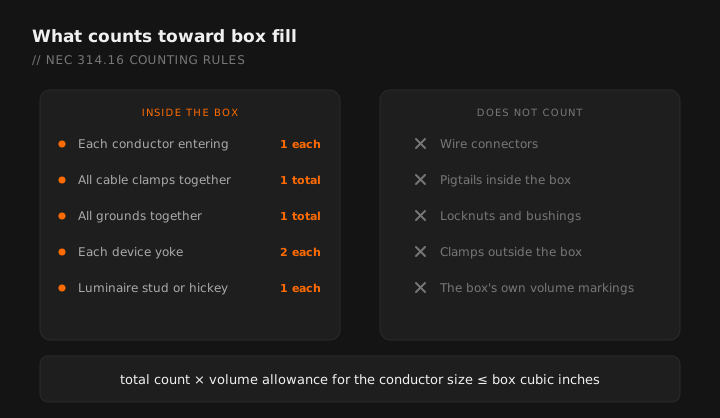
Conductors: one each, with a catch
Each insulated conductor that originates outside the box and terminates or is spliced inside counts as one. A conductor that passes through the box without splicing also counts as one, provided it is not longer than required. If a passing conductor is looped and the loop is at least twice the minimum required free length, it counts as two.
Conductors that begin and end inside the box, like a pigtail from a splice to a device, count as nothing. This is the rule people forget in the generous direction.
Cable clamps: one total
All internal cable clamps combined count as a single conductor volume, no matter how many are present. Clamps outside the box do not count at all. One is the number, not one per clamp.
Grounding conductors: one total
Every equipment grounding conductor in the box counts as one conductor volume together, sized to the largest one present. If a separate isolated grounding conductor is also present, that group counts as one more. So you can have six grounds in a box and count one.
Devices: two each
The app's box fill calculator counts devices, clamps and grounds for you and tells you the minimum cubic inches.
Each yoke or strap containing a device or utilization equipment counts as two conductor volumes, based on the largest conductor connected to that device. A single-pole switch counts the same as a four-way. A device that is wider than a single gang counts as two volumes for each gang it occupies.
Support fittings: one each type
One or more luminaire studs or hickeys count as a single conductor volume each, based on the largest conductor entering the box.
What does not count: wire connectors, pigtails contained entirely inside the box, small fittings such as locknuts and bushings, and conductors that do not leave the enclosure. If it never crosses the box wall, it is generally not counted.
The volume allowances
Once you have your count, convert it to cubic inches using the allowance for the conductor size. These figures come from Table 314.16(B) and have been stable across editions.
| Conductor size | Volume per conductor |
|---|---|
| 18 AWG | 1.50 cu in |
| 16 AWG | 1.75 cu in |
| 14 AWG | 2.00 cu in |
| 12 AWG | 2.25 cu in |
| 10 AWG | 2.50 cu in |
| 8 AWG | 3.00 cu in |
| 6 AWG | 5.00 cu in |
Where the box contains a mix of sizes, each conductor uses the allowance for its own size. But devices, clamps, grounds and support fittings all use the allowance for the largest conductor present in the box. That asymmetry is deliberate and it is where mixed-size calculations go sideways.
Common box volumes
Every box is required to be durably marked with its cubic inch capacity by the manufacturer. For standard boxes you can also use Table 314.16(A). These are the ones you meet most often:
| Box | Volume | 14 AWG max | 12 AWG max |
|---|---|---|---|
| 3 x 2 x 2 device | 10.0 cu in | 5 | 4 |
| 3 x 2 x 2½ device | 12.5 cu in | 6 | 5 |
| 3 x 2 x 3½ device | 18.0 cu in | 9 | 8 |
| 4 x 1¼ round or octagon | 15.5 cu in | 7 | 6 |
| 4 x 1½ square | 21.0 cu in | 10 | 9 |
| 4 x 2⅛ square | 30.3 cu in | 15 | 13 |
| 411⁄16 x 2⅛ square | 42.0 cu in | 21 | 18 |
The maximum conductor columns assume nothing else in the box. The moment you add a device and a clamp, those numbers drop fast.
Worked example: a standard switch box
A 3 x 2 x 2½ device box (12.5 cubic inches) with two 14/2 NM cables and one single-pole switch. Internal clamps.
Count:
Ungrounded conductors entering: 2 (one per cable) = 2
Grounded conductors entering: 2 = 2
Grounding conductors: all count as 1 = 1
Internal clamps: all count as 1 = 1
Switch on a yoke: 2
Total = 8 conductor volumes
Volume required: 8 × 2.00 cu in = 16.0 cubic inches
Verdict: The box holds 12.5. This fails. You need a 3 x 2 x 3½ box at 18.0 cubic inches, or a 4-square with a mud ring.
That is the whole point of running the calculation. A single switch with two cables in a shallow device box is an installation people make every day, and on paper it does not fit.
Worked example: mixed conductor sizes
A 4 x 1½ square box (21.0 cubic inches) with one 12/2 cable, one 10/2 cable passing through unbroken, and one duplex receptacle connected with the 12 AWG conductors. Internal clamps.
Count and volume, size by size:
12 AWG conductors entering (2): 2 × 2.25 = 4.50
10 AWG conductors passing through (2): 2 × 2.50 = 5.00
Grounding conductors, all as one, at the largest size (10 AWG): 1 × 2.50 = 2.50
Clamps, all as one, at the largest size: 1 × 2.50 = 2.50
Receptacle yoke, 2 volumes at the largest conductor connected to it (12 AWG): 2 × 2.25 = 4.50
Total = 19.00 cubic inches
Verdict: 19.00 required against 21.0 available. This passes, with very little room to spare.
Notice the device used the 12 AWG allowance because that is the largest conductor connected to the device, while the clamps and grounds used the 10 AWG allowance because that is the largest conductor in the box. That distinction is worth reading twice.
Where people lose points
- Counting each ground. Six grounds is one volume, not six. This is the single most common overcount.
- Counting the device as one. It is two. Every yoke, every time.
- Counting clamps individually. All internal clamps together are one.
- Counting pigtails. A conductor that never leaves the box does not count.
- Using the wrong allowance for the device. Largest conductor connected to that device, not largest in the box.
- Forgetting plaster rings add volume. Listed extension rings and mud rings are marked with their own cubic inch capacity, and you add it. This is the legitimate way out of a tight box.
Box fill and conduit fill are unrelated calculations. Box fill is cubic inches inside an enclosure. Conduit fill is cross-sectional area inside a raceway. Passing one tells you nothing about the other, and both get checked at rough-in.
The habit worth building
Do the calculation before you buy the boxes, not after you are trying to fold conductors into one. Overfilled boxes are one of the most commonly cited violations precisely because the decision that causes them is made at the supply house, weeks before anyone counts anything.
Enter conductor counts and devices, get the required volume. Free tier, works offline.
GET THE FIELD PACK
Two printables: the 22-point rough-in checklist, and branded panel schedules in 24, 30 and 42 circuit that print at 4 by 5 inches and slide straight into a panel sleeve. Enter your email and the downloads open right away.
You're set. Both are below.
Your address comes straight to Jason. No list rental, no spam, unsubscribe any time.