Three-phase math is four formulas and one constant. The theory behind it is genuinely interesting and completely unnecessary for doing the work. This is the field version.
The constant
1.732 is the square root of 3. It shows up in every three-phase formula because the three phases are offset by 120 degrees rather than being in step with each other. When you add three quantities that peak at different moments, the sum is not three times one of them. It works out to the square root of 3 times one of them.
You do not need to derive that. You need to know it is 1.732, and that it belongs on the bottom of the fraction when you are solving for current.
The four formulas
V is always the line-to-line voltage in these formulas. 208, 240, 480, 600. Not the line-to-neutral voltage.
The app's three-phase calculator handles kVA, kW, amps and power factor in one screen.
Worked examples
A 60 kVA panel at 208 volts, three-phase. What is the full load line current?
I = (60 × 1000) ÷ (208 × 1.732)
I = 60,000 ÷ 360.3
I = 166.5 amperes
I = 60,000 ÷ (480 × 1.732) = 60,000 ÷ 831.4 = 72.2 amperes
Same power, less than half the current, because the voltage is more than double. This is the entire reason commercial buildings distribute at 480 and step down locally.
A motor load reads 45 kW at 480 volts with a power factor of 0.85.
I = (45 × 1000) ÷ (480 × 1.732 × 0.85)
I = 45,000 ÷ 706.7
I = 63.7 amperes
Leave the 0.85 out and you get 54.1 amperes, which is 15 percent low. On a conductor sizing decision that is the difference between passing and cooking.
Wye and delta
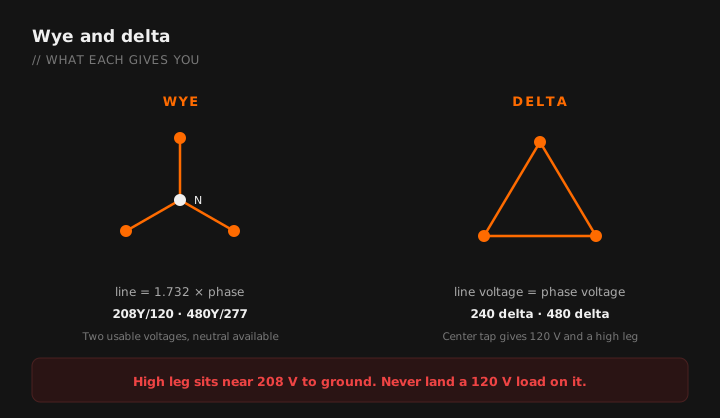
The configuration determines the relationship between line and phase quantities, and it determines which voltages are available to you.
| Wye | Delta | |
|---|---|---|
| Line voltage | 1.732 × phase voltage | Equal to phase voltage |
| Line current | Equal to phase current | 1.732 × phase current |
| Neutral | Yes, from the center point | Only with a center tap on one winding |
| Common systems | 208Y/120, 480Y/277 | 240 delta, 480 delta |
This is why 208Y/120 gives you two useful voltages from one system: 208 between any two phases for larger equipment, 120 from any phase to neutral for receptacles and lighting. 480Y/277 does the same thing at a higher level, with 277 being the standard commercial lighting voltage.
Common voltage pairs worth memorizing
| System | Line to line | Line to neutral |
|---|---|---|
| 208Y/120 | 208 V | 120 V |
| 240/120 delta | 240 V | 120 V from the tapped winding, 208 V on the high leg |
| 480Y/277 | 480 V | 277 V |
| 600Y/347 | 600 V | 347 V |
The high leg. On a 240 volt delta with one center-tapped winding, two phases sit at 120 volts to ground and the third sits at approximately 208 volts to ground. That third conductor is the high leg, sometimes called the wild leg or stinger. Landing a 120 volt load on it destroys the equipment. The code requires it be identified, commonly with orange marking, and placed in a specific position in panelboards and switchboards.
Two ninety-degree checks
These catch most arithmetic errors before they cost you.
The 208 to 480 ratio
Moving a given load from 208 to 480 volts cuts the current to roughly 43 percent. If your two numbers are not close to that ratio, one of them is wrong.
The three-phase to single-phase ratio
The same kVA on three-phase draws roughly 58 percent of the current it would on single-phase at the same line voltage. That is 1 divided by 1.732.
Balanced and unbalanced
All of the above assumes a balanced load, meaning each phase carries the same current. Real installations are rarely perfectly balanced, and on a wye system the neutral carries the imbalance.
Two consequences worth knowing:
- Balance the panel as you build it. Distributing single-phase loads evenly across the three phases keeps neutral current low and keeps the transformer from running hot on one winding.
- Nonlinear loads change the neutral rules. On systems feeding substantial electronic load, harmonic currents on the neutral do not cancel the way fundamental currents do, and the neutral can carry more current than any phase conductor. That neutral is then counted as a current-carrying conductor for ampacity adjustment.
Where three-phase math feeds into everything else
- Voltage drop uses 1.732 in place of the 2 in the single-phase formula, for the same reason.
- Transformer sizing runs the current formula twice, once per side.
- Motor circuits pull full-load current from the NEC tables rather than from these formulas, because table values account for real motor efficiency and power factor.
On motors, use the table. Calculating motor current from horsepower and voltage gives you a number that is usually close and occasionally not. The NEC motor tables exist because real motors have efficiency and power factor that vary by size and type, and the code requires you to use the table value for conductor and branch circuit sizing anyway.
kVA, kW, amps and power factor in the app. Free tier, works offline.
GET THE FIELD PACK
Two printables: the 22-point rough-in checklist, and branded panel schedules in 24, 30 and 42 circuit that print at 4 by 5 inches and slide straight into a panel sleeve. Enter your email and the downloads open right away.
You're set. Both are below.
Your address comes straight to Jason. No list rental, no spam, unsubscribe any time.