Most EV charger installations are a straightforward 240 volt circuit. The part that goes wrong is not the circuit, it is the service, and it goes wrong after you have already quoted the job.
Run the load calculation first. Everything else follows from it.
The one rule that drives everything
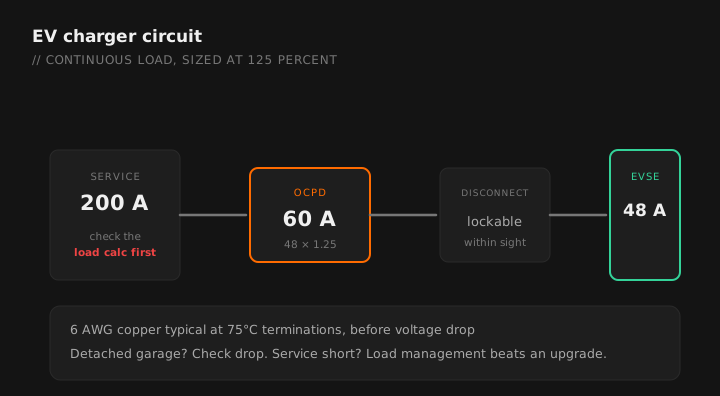
An EV charges for hours, which is exactly what "continuous" means in code terms. So the circuit is sized 25 percent above the charger's rating, always.
| Charger rating | × 1.25 | Circuit | Typical copper conductor |
|---|---|---|---|
| 16 A | 20 A | 20 A | 12 AWG |
| 24 A | 30 A | 30 A | 10 AWG |
| 32 A | 40 A | 40 A | 8 AWG |
| 40 A | 50 A | 50 A | 8 AWG at 75°C |
| 48 A | 60 A | 60 A | 6 AWG |
| 80 A | 100 A | 100 A | 3 AWG |
Conductor sizes assume 75 degree C terminations, three or fewer current-carrying conductors, normal ambient, and a run short enough that voltage drop is not controlling. Detached garages and long runs frequently change the answer.
The manufacturer's instructions are enforceable. Every listed charger specifies a minimum circuit ampacity and a maximum overcurrent device. Where those differ from your calculation, the instructions govern. Read them before you pull wire, not after.
Adjustable chargers
Many modern chargers have a selectable output, commonly settable from 16 up to 48 amperes. The code addresses this: where the equipment has an adjustable rating, the circuit is generally sized for the maximum the equipment is capable of, unless the adjustment is restricted by a means acceptable to the AHJ, such as a setting only accessible to qualified persons.
Run the load calculation in the app before you quote the panel, not after.
Practically: do not size a 40 amp circuit for a 48 amp capable charger set to 32 amps, unless you have confirmed how your jurisdiction treats the restriction. The homeowner can change that setting with an app.
The service is the actual problem
Here is the situation you meet constantly. Existing 150 amp service, house calculates at 146 amps, homeowner wants a 48 amp charger.
48 amperes × 1.25 = 60 amperes of calculated load at 240 volts.
60 × 240 = 14,400 VA added to the service calculation.
Existing calculated load: 34,970 VA (146 amps)
With the charger: 49,370 VA = 205.7 amperes
The 150 amp service is now short by a wide margin, and even a 200 amp service does not cover it.
That is a service upgrade: new panel, new service conductors, new meter base, utility coordination, and a permit. It routinely costs several times the charger installation itself, and it is the number that kills the sale if you discover it after quoting.
See how to run the load calculation before you set foot in the driveway.
The alternative: load management
This is the answer most people do not know exists, and it is often the difference between a $1,200 job and a $9,000 job.
The code recognizes energy management systems that limit the total load a service can draw. Where such a system is installed, the EV load may be calculated at the maximum the system permits rather than at the charger's full rating.
Three common implementations:
- A load management device that monitors total service current and throttles or interrupts the charger when the house approaches capacity.
- A branch circuit sharing device that interlocks the charger with another large load, most commonly an electric dryer, so both cannot draw at once.
- A charger with built-in load management, using a current transformer clamped on the service conductors. Increasingly common and often the cleanest install.
The economics are usually decisive. A load management device plus installation is typically a fraction of a service upgrade, and for a homeowner charging overnight the throttling is invisible. Present both options with real numbers and let them choose.
Ground-fault protection
Recent editions require ground-fault protection for personnel on EVSE receptacle outlets within specified ratings, and most listed chargers incorporate protection internally.
Two practical notes:
- Hardwired versus cord-and-plug matters. A charger on a 14-50 receptacle is subject to the receptacle rules; a hardwired unit is treated differently.
- Do not stack protection carelessly. A GFCI breaker ahead of a charger with its own internal ground-fault protection is a well-known source of nuisance tripping. Follow the manufacturer's instructions, which usually state exactly what upstream protection is acceptable.
Disconnecting means
EVSE rated above specified thresholds requires a disconnecting means, readily accessible and lockable in the open position, located within sight of the equipment. For typical residential chargers the branch circuit breaker often satisfies this where the panel is within sight; for larger equipment or remote panels, a local disconnect is required.
Installation details that come back
- Mounting height. There are limits on the height of the coupling and the cord, indoors and outdoors. Mounting a charger at eye level because it looked tidy is a correction.
- Cord management. The cable is required to be manageable and not create a tripping hazard across a walkway.
- Outdoor rating. Confirm the enclosure rating and that the receptacle, if used, is in a listed weatherproof enclosure suitable for a plug in place.
- Individual branch circuit. The charger gets its own circuit. It does not share.
- Conductor upsizing on long runs. Detached garages are common, and a 60 amp circuit over 120 feet frequently needs upsizing for voltage drop. If you upsize the phase conductors, the equipment grounding conductor is upsized proportionally too.
How to quote this correctly
- Load calculation before pricing. Not after. This is the whole game.
- Get the actual charger model. Rating, adjustability, internal protection and instructions all change the design.
- Measure the run. Then check voltage drop, then size conductors.
- Price both paths where the service is tight: load management versus service upgrade, with real numbers on each.
- Check panel capacity separately from service capacity. A 200 amp service with a full panel and no space for a two-pole 60 still needs work, just less of it.
- Confirm the adopted edition. EV requirements have moved in every recent cycle. See which edition your jurisdiction enforces and the 2026 changes.
Quote the load calculation as a line item if you have to. It is real work, it protects the customer from a bad surprise, and it protects you from eating a service upgrade you did not price.
Load calculations and breaker sizing in the app. Free tier, works offline.
GET THE FIELD PACK
Two printables: the 22-point rough-in checklist, and branded panel schedules in 24, 30 and 42 circuit that print at 4 by 5 inches and slide straight into a panel sleeve. Enter your email and the downloads open right away.
You're set. Both are below.
Your address comes straight to Jason. No list rental, no spam, unsubscribe any time.